


— News

Structural hollow sections are widely used in buildings, industrial facilities, bridges, machinery, solar mounting systems and infrastructure projects.
According to their cross-sectional shape, hollow steel sections are generally divided into three main categories: SHS, RHS and CHS. Although these products have similar manufacturing principles, their structural performance and suitable applications are different.
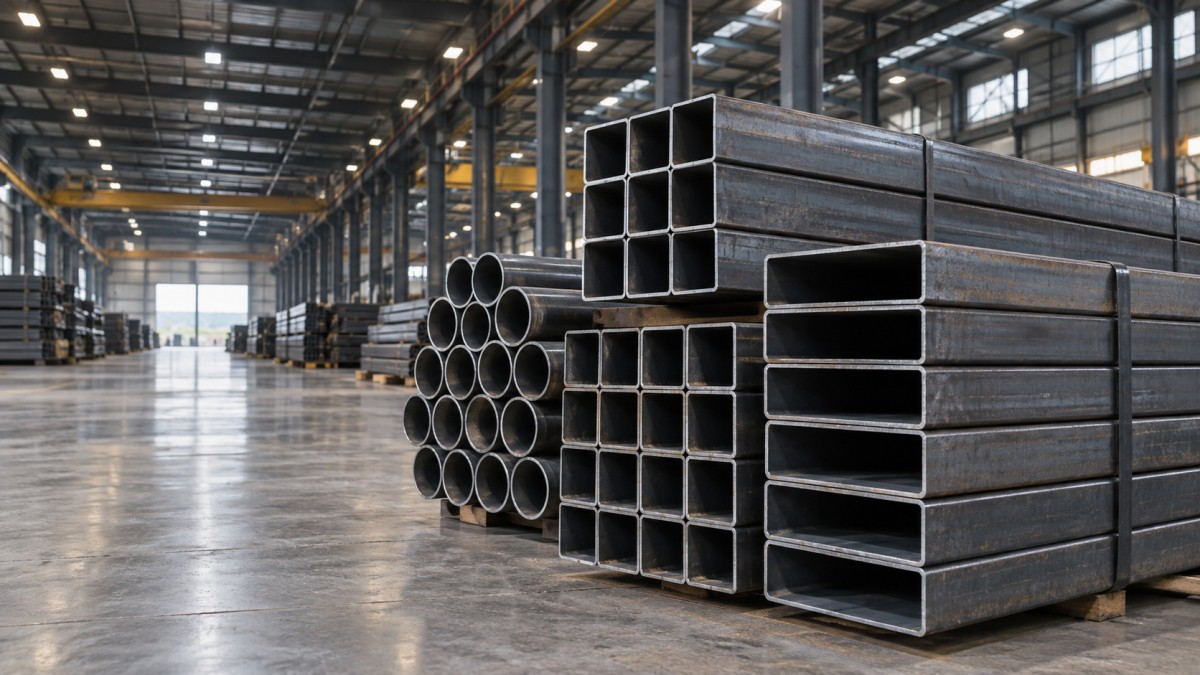
SHS, RHS and CHS structural steel tubes stored in a modern steel warehouse.
What Is SHS
SHS stands for Square Hollow Section. It has equal width and height, creating a symmetrical square cross-section.
Because an SHS profile provides similar structural performance in both directions, it is commonly used when loads may act from different sides.
Typical SHS applications include:
· Building columns
· Steel frames
· Support structures
· Fences and gates
· Machinery frames
· Solar mounting structures
· Architectural projects
Square hollow sections also provide a clean and modern appearance, making them suitable for projects where the steel structure remains visible.
What Is RHS
RHS stands for Rectangular Hollow Section. Its width and height are different, allowing engineers to select the stronger axis according to the direction of the load.
RHS products are commonly used for:
· Building beams
· Roof structures
· Industrial platforms
· Wall support systems
· Vehicle frames
· Equipment supports
· Warehouse structures
Compared with square sections, rectangular hollow sections can provide greater bending resistance in a specific direction. This makes RHS suitable for beams and other horizontal structural components.
What Is CHS
CHS stands for Circular Hollow Section. It has a round cross-section and distributes force evenly around the entire profile.
CHS products offer good resistance to compression and torsion. Their smooth surface also reduces wind resistance.
Common CHS applications include:
· Structural columns
· Transmission towers
· Stadium structures
· Bridges
· Handrails
· Pipelines
· Offshore structures
· Architectural supports
Main Differences Between SHS RHS and CHS
Cross Sectional Shape
SHS has a square profile, RHS has a rectangular profile and CHS has a circular profile. The correct shape depends on the load direction, connection method and architectural requirements.
Structural Performance
SHS performs similarly along both principal axes. RHS can provide greater strength along one selected axis, while CHS performs efficiently under compression and torsional loads.
Connection and Fabrication
The flat surfaces of SHS and RHS make welding, bolting and connecting other components relatively straightforward. CHS may require specially designed connection plates or cutting methods because of its curved surface.
Appearance
SHS and RHS provide straight, clean lines that are suitable for modern buildings and industrial structures. CHS provides a smooth appearance and is often used in exposed architectural structures.
Common Manufacturing Standards
The applicable standard depends on the market and project requirements. Common international standards include:
· ASTM A500
· ASTM A1085
· EN 10210
· EN 10219
· JIS G3466
· GB/T 6728
These standards specify requirements for dimensions, tolerances, chemical composition, mechanical properties and testing methods. Buyers should confirm the required standard and steel grade before requesting a quotation.

Structural hollow steel sections used in a large commercial construction project.
Common Surface Treatments
Structural hollow sections can be supplied with different surface treatments according to the installation environment:
· Black mill finish
· Anti-rust oil
· Painted surface
· Powder coating
· Hot-dip galvanizing
· Customized protective coating
For outdoor, humid or coastal projects, galvanized steel or additional anti-corrosion treatment may be necessary. The required zinc coating thickness should be confirmed before production.
Information Required for a Quotation
To receive an accurate quotation for SHS, RHS or CHS products, buyers should provide:
1. Product type: SHS, RHS or CHS
2. Outside dimensions or diameter
3. Wall thickness
4. Steel grade
5. Required standard
6. Product length
7. Surface treatment
8. Required quantity
9. Processing requirements
10. Destination port
If the products will be used in a specific engineering project, drawings and technical specifications should also be provided.
How to Select the Right Hollow Section
SHS is often suitable for columns, frames and structures requiring similar strength in multiple directions.
RHS is generally preferred for beams and applications where the primary load acts in one direction.
CHS is suitable for columns, towers, bridges and structures exposed to torsion or wind loads.
The final selection should be based on structural calculations, connection design, installation environment and applicable project standards.
Conclusion
SHS, RHS and CHS products each offer different structural and fabrication advantages. Choosing the correct section can improve project safety, simplify installation and reduce unnecessary material costs.
Before placing an order, buyers should confirm the steel grade, dimensions, wall thickness, standard, surface treatment and inspection requirements.
Contact our team for structural hollow sections, steel pipes, steel profiles and customized steel supply solutions.
Leave A Message
If you are interested in our products and want to know more details, please leave a message here, we will reply you as soon as we can.